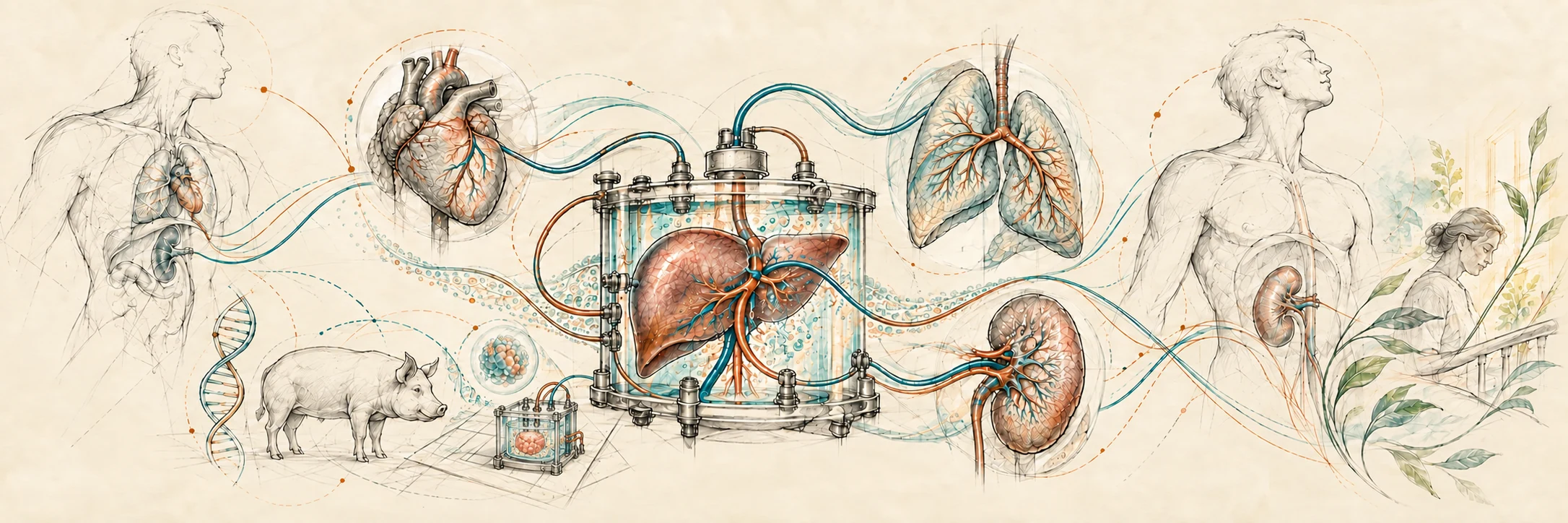
Organ transplantation is entering a new era of technological innovation. However, access to advanced perfusion systems, organ assessment technologies and specialized research infrastructure remains limited by cost, complexity and availability.
BHOC Transplant invites universities, transplant centres, biomedical engineers, scientists, medical device developers and industry partners worldwide to explore collaboration through a proposed international Organ Sustainability Initiative.
Our objective is to connect existing scientific achievements, affordable engineering solutions and emerging approaches to functional oxygen delivery, with the ultimate goal of improving organ sustainability and expanding transplantation opportunities.
Precision Oxygenation, Hemoglobin and Organ Sustainability
Precision Oxygen Therapeutics brings together hemoglobin biology, oxygen delivery and tissue-level oxygenation. In transplantation research, the relevant question is not simply whether oxygen is present, but whether oxygen can be delivered through perfused microcirculation, diffuse into tissue and be used by cells under the conditions being studied.
Hemoglobin is a central biological oxygen-transport protein. Hemoglobin-based oxygen carriers (HBOCs) are therefore relevant to research into cell-free oxygen transport and oxygen-carrying perfusates. Their potential role in organ perfusion must be evaluated in specific experimental models; this initiative does not claim that BHOC has demonstrated transplant efficacy or an approved transplant indication.
Here, oxygenation is considered in the broader physiological sense: oxygen availability, delivery, tissue distribution and cellular utilization. It is connected to perfusion, microcirculation, organ metabolism and mitochondrial function.
Organ Sustainability is broader than organ preservation. Preservation remains one important part of transplantation, while sustainability focuses on understanding and supporting organ function across the wider transplantation pathway.
Read the BHOC Therapeutics overview of Precision Oxygen Therapeutics and the BHOC Veterinary comparative research programme.
We welcome expressions of interest, joint research proposals, institutional partnerships and CRADA-style collaborative research agreements.
Some International Research and Innovation Projects
1. COARO — Affordable Liver Perfusion System
The Centre for Organ Assessment, Repair and Optimisation developed an institutionally designed hypothermic oxygenated perfusion (HOPE) system using readily available components. The reported system cost was US$1,494.87 per liver transplant, approximately 80% less than a commercial equivalent. The pilot reported 45 liver transplants using the system.
Research team: Charles W. G. Risbey, Daniel Babekuhl, Paul Yousif, Nidula Fonseka, Wesley B. Zhang, Edmund Derwent, Spencer Curry, Chloe Seow, Anita Niu, Ken Liu, Simone I. Strasser, Geoffrey W. McCaughan, Michael Crawford and Carlo Pulitano.
Research leadership: Associate Professor Carlo Pulitano.
Original research — PubMed ↗ · COARO — Sydney Local Health District ↗
2. Ultra-Low-Cost Open-Source Organ Perfusion Platform
Researchers developed an experimental normothermic ex vivo organ perfusion platform using recycled, repurposed and low-cost components, with an estimated equipment cost of approximately US$2,000. The system perfused porcine kidneys and non-transplantable human kidneys, pancreas and spleen for up to 24 hours. Porcine kidneys subsequently demonstrated in-vivo function following autotransplantation, with 30-day survival in the experimental model.
Authors and researchers: Heiko Yang, Nicholas Higgins, Simon Chu, Jean Lee, Natalie Meyer, Keith Hansen, Mustafa Saeed, Ryan Ferreira, Thomas A. Sorrentino, Jorge Mena, Pablo Suarez, Feres Camargo Maluf, Wilson Sui, Maria C. Velasquez, Uday Mann, Hillary Braun, Juan Du, Jacob Elmer, Thomas Chi, Shuvo Roy, Alan Flake, James M. Gardner and Marshall Stoller.
3. IMPACT — Innovative Machine Perfusion for Advancing Clinical Transplantation
IMPACT is a public-private research programme supported by €1.2 million in PPP funding through Health~Holland. It supports collaborative projects in machine perfusion, organ preservation, assessment and repair across heart, lung, liver and kidney transplantation. Its programme priorities also include organ viability, regeneration and reducing immunogenicity.
Programme leadership — University Medical Center Groningen: Prof. Vincent E. de Meijer, Gertrude Nieuwenhuijs-Moeke, Cyril Moers, Henri Leuvenink, Michiel Erasmus, J.A. (Ton) Lisman and Roland Hoffman.
Programme leadership — Erasmus MC: Robert Porte, Olivier Manintveld, Liset Pengel, Jeroen de Jonge, Robert Minnee, Yannick Taverne and Niels van der Kaaij.
IMPACT programme and consortium ↗ · Erasmus MC programme page ↗
4. No Kidney Left Behind — Centralized Kidney Assessment and Repair
This initiative explores centralized assessment and recovery of donor kidneys that might otherwise be discarded. Between April 2024 and May 2025, 158 unused deceased-donor kidneys were transported to the centralized Assessment and Repair Center. Following assessment using sub-normothermic acellular perfusion (SNAP), 142 were transplanted.
Authors: Christopher L. Jaynes, William C. Goggins, Matthew L. Holzner, Jacqueline Garonzik-Wang and Henri G. D. Leuvenink.
5. BMI OrganBank — Advanced Organ Perfusion Technologies
BMI OrganBank develops technologies for ex-vivo organ perfusion, assessment and preservation. Its kidney preservation device received FDA Breakthrough Device Designation in August 2025. The company describes research collaborations involving Duke University's Ex Vivo Organ Laboratory and the Wake Forest Institute for Regenerative Medicine.
Key scientific and technical leadership: Carrie DiMarzio (Co-Founder and CEO), David Gerber (Chief Medical Officer), Andrew S. Barbas (Chief Science Officer), Varun Kopparthy (Chief Technology Officer), Chip Aardema (Head of Perfusion), Josh Copus (Research Engineer), Carly Sison (Lead OrganBank Perfusionist) and Tyler Adcock (Research Engineer).
Scientific advisors: David A. Axelrod, Matthew Hartwig and Prabir Roy-Chaudhury.
BMI OrganBank — Our Company ↗ · FDA Breakthrough Device Designation announcement ↗ · Announcement via PR Newswire ↗
6. Portable Liver Perfusion Device — Liver, Laugh, Love
An engineering project developing a portable, cost-conscious hypothermic liver perfusion device with dual pumps, phase-change cooling and app-based real-time monitoring. The team received a tie for Best Overall Project at the Georgia Tech Spring 2026 Capstone Expo.
Engineering team: Kavya Laghate, Brennan Long, Dhruv Nambiar, Vibha Narasayya, Ritu Rai and Shobana Santhanam.
Faculty mentors: Dr. Marwan Kazimi and Dr. Steven Kim.
Areas of Proposed Collaboration
BHOC Transplant welcomes proposals and expressions of interest in:
- Affordable and accessible organ perfusion technologies.
- Functional oxygen delivery and tissue oxygenation.
- Organ metabolism, mitochondrial function and viability assessment.
- Development of portable and automated perfusion systems.
- Experimental evaluation of oxygen-carrying solutions in organ perfusion models.
- Organ sustainability, transplantation research and clinical translation.
- International academic cooperation, engineering partnerships and joint publications.
An Invitation to Collaborate
We believe that the next generation of transplantation technologies will come from collaboration between scientists, clinicians, engineers and innovative biotechnology companies.
BHOC Transplant invites the researchers and institutions featured here, together with other interested international partners, to open a dialogue about potential joint projects, research protocols, technology development and collaborative agreements.
Our proposed framework includes academic cooperation, joint laboratory studies, CRADA-style research collaborations where applicable, and opportunities for technology transfer and clinical research development.
An Open Invitation to the Global Transplant Community
This initiative is open to everyone who believes that organ sustainability and transplantation technologies can be improved through international scientific cooperation.
We welcome researchers, transplant surgeons, perfusion specialists, biomedical engineers, scientists, universities, medical device developers, biotechnology companies, investors and other professionals who wish to contribute their knowledge, experience and ideas.
- Share ideas, technical proposals and recommendations.
- Identify opportunities to improve existing perfusion technologies.
- Raise scientific and engineering questions, including critical questions that may open new research directions.
- Propose joint laboratory studies, experimental protocols and collaborative projects.
- Introduce experts, institutions and technology developers who could contribute.
- Help identify opportunities for funding, academic cooperation and international research partnerships.
We also invite all advocates of this initiative, and particularly Jeff Parke, to help bring greater visibility to this international effort, raise questions, engage additional specialists and expand the community of people interested in contributing to its development.
We encourage Mr. Jeff Parke, the Cold Ischemia Foundation, interested colleagues and companies to share their perspectives, challenge existing assumptions, suggest additional research directions and help identify people and organizations that should become part of this international dialogue.
This is not intended to be a closed project or a predefined technological pathway. We want to build an open international platform where existing achievements can be connected, new ideas can be evaluated, and practical improvements can emerge through collaboration.
We do not expect every participant to have the same approach or the same answers. We want to bring together different perspectives, expertise and technologies to identify better solutions.
If you have an idea, a question, a technology or research experience, we want to hear from you.
Send your proposals, comments, recommendations and expressions of interest through the BHOC Transplant contact page.
Every meaningful contribution, scientific question and new professional connection can help move this initiative forward.
Let's expand the circle of people working to make more organs viable, more technologies accessible and more transplantation opportunities possible.
Questions about the initiative
What is the Organ Sustainability Initiative?
A proposed international collaboration framework connecting research, affordable engineering and organ-perfusion technologies with studies of organ function and oxygen delivery.
Who is invited to participate?
Universities, transplant centres, clinicians, perfusion specialists, biomedical engineers, scientists, device developers, biotechnology companies and other interested professionals.
Does inclusion of a project mean that BHOC has a partnership with that institution?
No. These projects are presented as examples of relevant research and innovation. Their inclusion does not imply a formal partnership, endorsement or institutional commitment.
How can I contribute?
Send your questions, proposals or expression of interest through the BHOC Transplant contact page.
What is the connection between hemoglobin and precision oxygenation?
Hemoglobin binds and transports oxygen. Precision Oxygen Therapeutics studies oxygen-carrying function in relation to delivery, tissue oxygenation, microcirculation and cellular utilization. Hemoglobin-based oxygen carriers remain subject to product- and model-specific research and validation.
Does this initiative claim that BHOC is proven for organ transplantation?
No. BHOC is a research and development platform. This initiative does not establish BHOC-specific transplant efficacy, safety or regulatory approval.
Source announcement: Original BHOC LinkedIn publication ↗